

Comparisons ManicTime Alternatives: 7 Trackers Compared
Nov 14, 2026 · 10 min read

ManicTime Alternatives: 7 Trackers Compared
ManicTime alternatives as of November 2026: ActivityWatch, Memtime, Timing, Rize, Timely, RescueTime and TimeUno, by platform, data location and fit.
The best ManicTime alternatives in 2026
The best ManicTime alternatives are ActivityWatch (free, local, open source), Memtime (local, Windows, Mac and Linux), Timing (Mac only), Rize, Timely, RescueTime and TimeUno. Which one fits depends on what you value in ManicTime: local data, a one-time licence, Linux support or detailed tagging. Facts below are as of November 2026, and prices are on each vendor's pricing page.
Last reviewed: November 2026.
ManicTime is a solid tracker and many people should stay with it. This list is for the ones who hit a limit: a subscription they would rather not run, a platform it does not cover, or a wish for AI tool tracking.
TimeUno, one of the seven, is an automatic time tracker for macOS and Windows that records the app in front of you and your AI tools. It has an MCP server.
| Tool | Platforms | Data | Pricing | Best for |
|---|---|---|---|---|
| ManicTime | Windows, Mac, Linux, Android, iOS | Local, self-hosted or cloud | See ManicTime pricing | Local data, one-time payment |
| ActivityWatch | Windows, macOS, Linux, Android | Local; optional device sync, set up by hand | Free and open source | Privacy, tinkering |
| Memtime | Windows, macOS, Linux | Offline on your device, no sync | See Memtime pricing | Local data with team billing |
| Timing | macOS | Cloud sync | See Timing pricing | Mac users, filters |
| Rize | macOS, Windows | Cloud | See Rize pricing | AI focus insights, client reports |
| Timely | Web, iOS, Android; Memory tracking app for Mac and Windows | Cloud | See Timely pricing | Agencies and project budgets |
| RescueTime | Web, mobile, desktop (no official Linux support) | Cloud | See RescueTime pricing | Focus goals, distraction blocking |
| TimeUno | macOS, Windows | Cloud | $9.99 a month ($8.33 billed yearly), 14-day trial | Tracking AI tools next to your own time |
What does ManicTime do today?
ManicTime tracks apps, documents and websites automatically, then lets you tag the time to projects. It runs on Windows, Mac, Linux, Android and iOS, and you pick local, self-hosted or cloud storage.
ManicTime sells three ways (ManicTime pricing, ManicTime licence guide):
- Free version: ManicTime offers a free Windows version.
- On-premise licence: a one-time payment per user, with all data on your hardware. It covers versions released within a year of purchase, and you can keep the old version or renew after that.
- Cloud subscription: Standard, Ultimate and Ultimate AI tiers add more devices, cloud screenshots and AI tagging. The licence stops working when the subscription ends.
See the pricing page for current prices, discounts and trial terms.
Where is ManicTime better?
ManicTime keeps data on your machine if you want, lets you pay once, and covers Linux and Windows. It also has optional screenshots and a self-hosted server.
If any of these is why you chose it, consider staying:
- You want a one-time licence. Among these tools, ManicTime's "one year of upgrades, then keep the version you have" model is the exception.
- Your data must stay local. ManicTime on-premise, Memtime and ActivityWatch are built around local storage.
- You use Linux. ManicTime, Memtime and ActivityWatch run on it. RescueTime lists Linux as unsupported. TimeUno has no Linux desktop app, only a headless agent for servers.
- You rely on tagging by hand. ManicTime's tag-and-validate workflow is built for it.
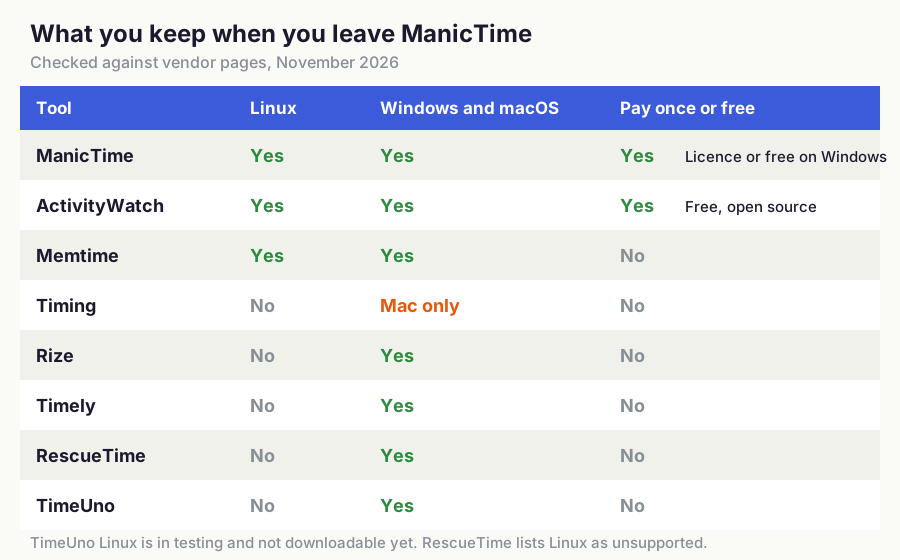
Figure 1: What you keep when you leave ManicTime. Sources: vendor pricing and platform pages listed under Sources, November 2026.
Is ActivityWatch a good free ManicTime alternative?
ActivityWatch is a free, open-source tracker (MPL-2.0 licence) for Windows, macOS, Linux and Android. All data stays on your device, and you read it in a local web page at localhost:5600 (ActivityWatch).
It tracks the active app and window title, with browser extensions for Chrome and Firefox and editor plugins for coding time. Its site crosses out device sync on the feature list, and its October 2026 sync post says sync is opt-in, set up by hand, and not yet complete (the Android app sends data but does not import). Do not expect a cloud timeline.
Pick it if you want no subscription and full control. Skip it if you need client timesheets, rates or a team view: you would build those yourself. More free options are in our open-source time trackers list.
Is Memtime a good ManicTime alternative for local data?
Memtime is an automatic tracker for Windows, macOS and Linux that keeps your activity data offline on your device and never uploads it. Data is not synced across devices (Memtime pricing and features).
Basic is for freelancers and small teams who do not use project software, and Connect adds integrations for teams that do. Pick Memtime if you want ManicTime's local-first approach on all three systems, and read our Memtime alternatives page for the other side of that choice.
Is Timing a good ManicTime alternative on Mac?
Timing is an automatic time tracker built for macOS only. It is a subscription with several plans, and its pricing page lists what each one includes (Timing pricing). It does nothing for Windows. Mac users who want fine-grained rules should compare it with TimeUno on our Timing comparison page.
Is Rize a good ManicTime alternative for focus insights?
Rize tracks apps and websites on macOS and Windows and adds AI categorisation, focus insights and smart breaks. Plans and prices are on Rize pricing.
AI features run on monthly credits. Rize has no Linux version. Pick Rize if you want AI focus insights. See the full TimeUno vs Rize comparison.
Is Timely a good ManicTime alternative for agencies?
Timely is aimed at teams that need project budgets and capacity. Plans and prices are on Timely pricing. Automatic tracking runs through Timely's Memory app for Mac or Windows (Timely pricing, Timely platforms).
It suits agencies that plan work and watch budgets, and is more tool than a solo freelancer needs. More options are in our list of Timely alternatives.
Is RescueTime a good ManicTime alternative for focus?
RescueTime is a hosted option with Solo and Solo+ plans, and Solo+ adds more features (RescueTime pricing).
It is strong on focus and light on billing. RescueTime's own community team has described Linux as unsupported for several years, so Linux users should look elsewhere (RescueTime on Linux).
Is TimeUno a good ManicTime alternative for AI tools?
TimeUno records two timelines side by side: the app or site in front of you, and your AI tools (Claude Code, Cursor, Codex CLI and others) working, waiting or done. It runs on macOS and Windows and tracks without timers.
TimeUno takes no screenshots. It records the app, window title and idle time, never what you type, and can read on-screen text, which an owner or admin can switch off (privacy details). Data is stored on TimeUno's servers. The MCP docs show how an assistant reads both.
Timesheets are built from tracked project time and export as CSV or PDF. TimeUno does not create invoices, has no Excel export and has no mobile app.
TimeUno costs $9.99 a month ($8.33 billed yearly) for individuals, as of November 2026 (pricing). There is no free plan, only a 14-day trial. TimeUno also has an MCP server at app.timeuno.io/mcp, so an AI assistant can query your tracked time.
Pick it if AI tools are part of your work and you want to see how much of a project they carried. Skip it if you need a Linux desktop app, a local-only database or a one-time licence.
Which ManicTime alternative should you pick?
Match the tool to your reason for leaving, or for staying. If ManicTime still works, the cheapest move is to keep it.
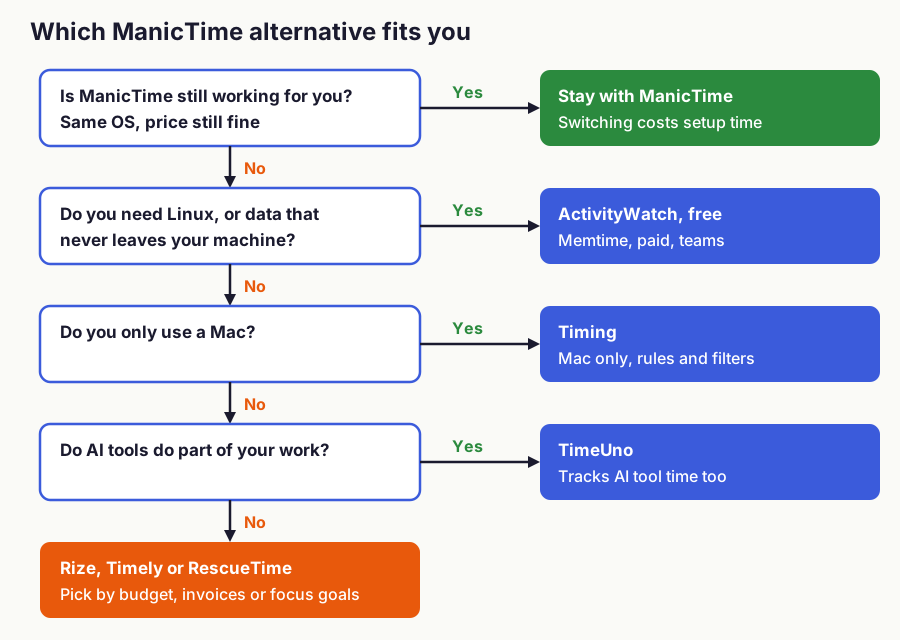
Figure 2: Pick an alternative by your first blocking need. Based on the platform and pricing facts in this post.
| Your situation | Pick |
|---|---|
| Want a one-time payment and local data | Stay with ManicTime (on-premise licence) |
| Want free and open source | ActivityWatch |
| Want local data on Windows, Mac and Linux, with team billing | Memtime |
| Mac only, want filters for sorting activity | Timing |
| Want AI focus insights and client reports in one tool | Rize |
| Agency with budgets and capacity planning | Timely |
| Want focus goals and distraction blocking | RescueTime |
| Use Claude Code, Cursor or Codex and bill by project | TimeUno |
If you are still choosing between automatic trackers, our best automatic time trackers of 2026 list covers more of the field.
How do you switch from ManicTime without losing history?
Keep ManicTime installed read-only for a month and run the new tool in parallel. Do not count on moving history between these tools, so export the reports you need first and store them where your clients can reach them.
- Export the last 12 months of ManicTime reports or timesheets you may need for audits.
- Install the new tracker and let it run for one working week.
- Compare totals per project for that week against ManicTime. A gap above about 10 percent usually means a missing rule or tag.
- Rebuild your project rules in the new tool.
- Uninstall ManicTime only after your next billing cycle closes.
The 10 percent figure is a rule of thumb for spotting setup gaps, not a measured benchmark.
Where can you try TimeUno next to ManicTime?
If your day includes AI tools, run TimeUno for the 14-day trial and compare one week against ManicTime. See what TimeUno costs before you start.
FAQ
What is the best ManicTime alternative?
The best ManicTime alternative depends on why you are leaving. ActivityWatch fits people who want free, local, open-source tracking, Memtime fits teams that want local data, and TimeUno fits people who want to track AI tools next to their own time.
Is there a free ManicTime alternative?
Yes, ActivityWatch is a free, open-source ManicTime alternative for Windows, macOS, Linux and Android. ManicTime itself also has a free Windows version. TimeUno is not free: it has no free plan, only a 14-day trial.
How much does ManicTime cost?
See ManicTime pricing for current prices. It sells a cloud subscription and a one-time on-premise licence per user with a year of upgrades, and offers a free Windows version.
Which ManicTime alternatives work on Mac and Windows?
Rize, Memtime and TimeUno run on macOS and Windows, and Memtime and ActivityWatch also cover Linux. Timing is Mac only, and TimeUno has no Linux desktop app.
How much does TimeUno cost compared with ManicTime?
TimeUno costs $9.99 a month for individuals ($8.33 billed yearly), with a 14-day trial. ManicTime's one-time licence has no monthly fee, and its cloud prices are on its pricing page.